
ACMA’s Sender ID Register: What AU eCommerce Brands Must Fix Before 1 July 2026
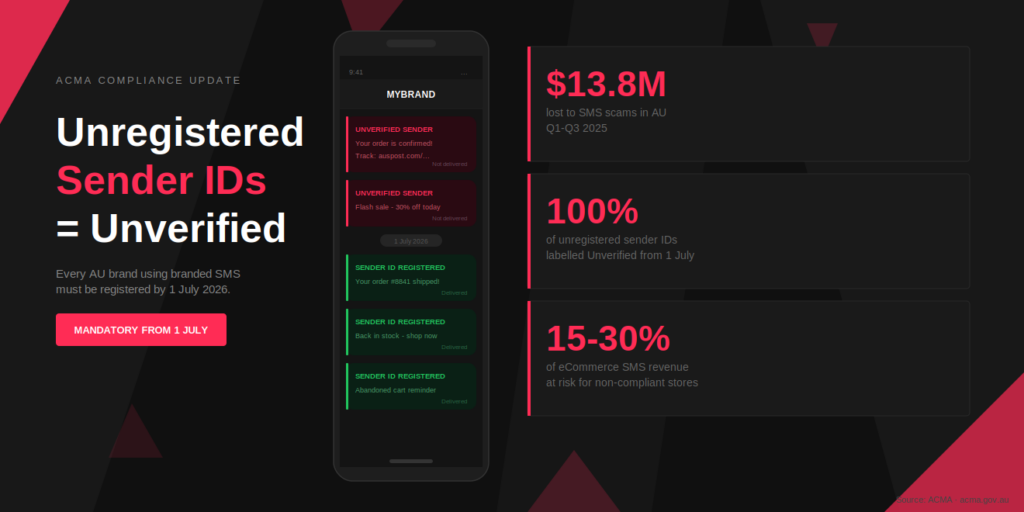
Australia’s SMS Sender ID Register becomes mandatory on 1 July 2026, and it brings crucial changes for eCommerce brands. If your company sends marketing or transactional SMS under a named sender — not a phone number — and that name isn’t registered with ACMA, your messages will be blocked. How’s that working, and what to do? In this guide, you’ll find all the answers.
Why Did ACMA Introduce Registration Requirements?
Australia lost $13.8 million to SMS scams in just the first three quarters of 2025. Scammers routinely fake banks, telcos, and eCommerce brands by spoofing alphanumeric sender names — the kind that display as “YOURBRAND”. Consumers trusted those names, and impostors exploited that trust at scale.
The ACMA Sender ID Register is the government’s response. From 1 July 2026, telcos will be legally required to block any SMS sent from an unregistered alphanumeric Sender ID. That means if your Klaviyo account is configured to send SMS under your brand name and that name isn’t in the register, your messages will go nowhere — no delivery, no error notification, no revenue.
What Is a Sender ID, and Do You Have One?
A Sender ID is the alphanumeric name that appears in the “From” field of an SMS instead of a phone number. In other words, if your customer receives a text that reads “From: MYBRAND” rather than “+61 4XX XXX XXX”, you’re using a Sender ID.
It’s a specific SMS configuration, so not all businesses use it. Some brands send from dedicated long codes (full phone numbers) or short codes. If you’re one of them, you have nothing to worry about right now.
The primary focus of the new regime is branded alphanumeric Sender IDs, as they’re the most common configuration for Australian eCommerce brands and are most affected by scammers.
To check whether you use Sender ID, go to your Klaviyo SMS settings under Settings → SMS → Sending Numbers. If you see an alphanumeric name rather than a number, you have a Sender ID that requires registration.
Why Is It Important for eCommerce Brands?
SMS is a direct revenue driver for most eCommerce businesses. Abandoned cart flows, post-purchase sequences, flash sale alerts, back-in-stock notifications, loyalty rewards — all these SMS notifications routinely contribute 15-30% of email-attributed revenue for Klaviyo-powered stores. Earnings will drop immediately if that channel goes dark.
That’s why eCommerce companies are actively responding to the new SMS framework, and many brands have already registered. Applications for Sender ID registration have been open since 30 November 2025, so there was plenty of time. However, many US-focused digital agencies managing Australian eCommerce accounts were slow to pick up on this regulation. Australian brands working with locally based specialists had a competitive advantage because they better understood the regulatory environment and acted early.
Phone Number instead of Sender ID: Will It Help?
Some brands are exploring switching to numeric phone number senders to avoid the block. This approach does sidestep the Sender ID requirement but also eliminates brand recognition, significantly reduces open rates, and puts your messages in the same visual space as the scam texts the regulation was designed to stop. It’s not a viable long-term strategy.
Compliance is the best option, and LION Digital can help your eCommerce brand survive. As a Klaviyo Master Elite Partner — one of a small number of agencies at this tier in Australia — LION Digital is currently helping businesses audit their Sender ID configurations, submit registrations, and restructure SMS flows to prevent revenue disruption on 1 July.
What You Need to Do Before 1 July 2026: Step by Step
Send the application now. Registration review typically takes several business days, and there’s not much time left before the deadline.
Here’s the step-by-step instructions:
- Check your Klaviyo SMS settings: Settings → SMS → Sending Numbers and identify all sender names in use across all active flows. Each name requires a separate registration.
- Submit your Sender ID registration at acma.gov.au. You’ll need your ABN/ACN and documentation to verify business identity.
- Do not create any new alphanumeric Sender IDs before the deadline unless they are also submitted for registration.
- Once ACMA approves your registration, verify the sender name is correctly configured in Klaviyo before the cutover date.
- Brief your team that no ad-hoc sender names should be created after 1 July without a corresponding registration.
What Happens If You Don’t Register Sender ID Before 1 July 2026
The deadline is only weeks away, so you must register ASAP. If you won’t make it in time, your business will have to deal with the consequences:
Messages will be blocked at the network level
Telcos don’t return error codes for blocked Sender IDs the way email does for hard bounces. Your Klaviyo flows will continue to “send”, but the carrier will silently drop the messages before they reach the subscriber’s handset. You won’t realise the problem unless you’re watching delivery rates closely.
Your automated revenue flows go offline
Every SMS flow tied to an unregistered Sender ID becomes non-functional from 1 July. Abandoned cart, welcome series, post-purchase, winback — all your highest-ROI automations will go dark, and the revenue doesn’t shift to another channel. It’s lost.
Analytics and attribution become unreliable
Klaviyo will continue to register sends even when delivery is blocked, so you can’t trust the numbers. Your SMS delivery rate will collapse, and your attributed revenue will drop sharply. Plus, if you’re using SMS and email attribution windows together, the data distortion flows through to your overall channel reporting.
Regulatory risk for persistent non-compliance
Deliberately avoiding the register — for example, rotating between unregistered sender names to avoid telco-level blocking — carries civil penalties. ACMA has demonstrated it will act. The Spam Act framework is well established in Australia, and this register extends it to SMS in a meaningful way.
Your Smarter SMS Strategy Going Forward
ID register regulation is the beginning of a more structured compliance environment for SMS in Australia. ACMA has signalled that consent verification and record-keeping requirements for SMS are likely to be tightened in subsequent phases — essentially extending the existing Spam Act protections more explicitly into the channel.
It’s just a beginning, and brands should treat this as a foundation-building moment. Implement clean consent capture, proper Sender ID registration, documented suppression logic, and ensure SMS flows perform within whatever the next iteration of the rules looks like.
Having registered Sender IDs is particularly meaningful for Klaviyo users, unlocking the full range of Klaviyo’s SMS capabilities, including conversational SMS, two-way flows, and expanded A/B testing.
If you want to make sure your Klaviyo SMS setup is fully registered and optimised before 1 July, the LION Digital team can help. We’ll audit your current configuration, guide your registration submissions, and ensure your flows are protected at cutover.
Get in touch for a complimentary eCommerce audit!
FAQs
1. What is the ACMA Sender ID Register?
It’s a mandatory registry operated by the Australian Communications and Media Authority that requires businesses to pre-register any alphanumeric sender name used to send SMS. From 1 July 2026, telcos are required to block SMS from unregistered Sender IDs.
2. Does this affect all businesses sending SMS in Australia?
It specifically affects businesses that use alphanumeric Sender IDs — branded names like “YOURBRAND” rather than phone numbers. Businesses sending from numeric long codes or short codes have different requirements. If you’re unsure which applies to you, check your SMS platform’s sender settings or contact LION Digital for assistance.
3. What happens if I don’t register before 1 July?
From 1 July, telcos will block any SMS sent from an unregistered alphanumeric Sender ID. Your Klaviyo flows will continue to show as sent, but messages won’t reach subscribers. You get zero delivery on all branded SMS until you’re registered.
Register through the ACMA portal now to avoid any gap in your channel.
4. How long does registration take?
ACMA typically takes several business days to review and approve Sender ID applications. Submitting complete documentation, including ABN/ACN verification and clear business identity details, helps avoid delays. If you’re not sure what documentation’s needed and how to register, LION Digital can help you with that.
5. Do I need to register each Sender ID separately?
Yes, each alphanumeric Sender ID requires its own individual registration. If your business uses multiple branded names across different SMS communications, audit all of them and submit separate applications.
6. How can LION Digital help with Sender ID registration?
As a Klaviyo Master Elite Partner, we’ve been ahead of this deadline since it was announced. We can audit your current Klaviyo SMS configuration, identify every Sender ID in use, guide your registration submissions, and restructure your flows to ensure compliance without sacrificing performance.